Friday, January 18, 2008

18 Jan 08


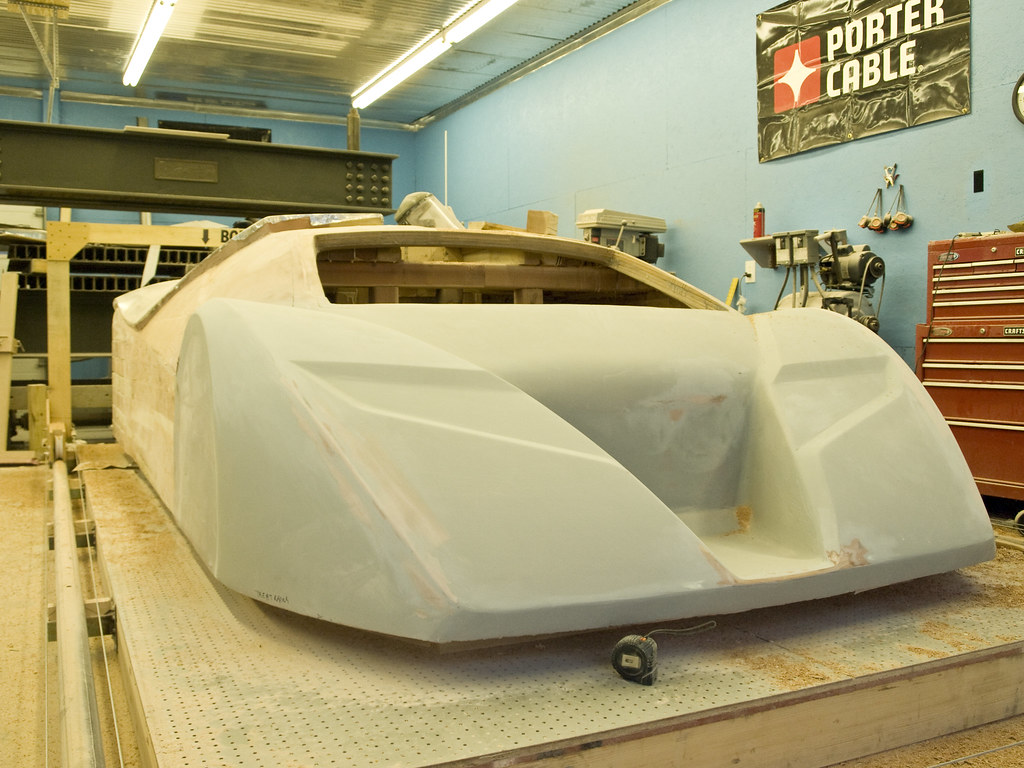
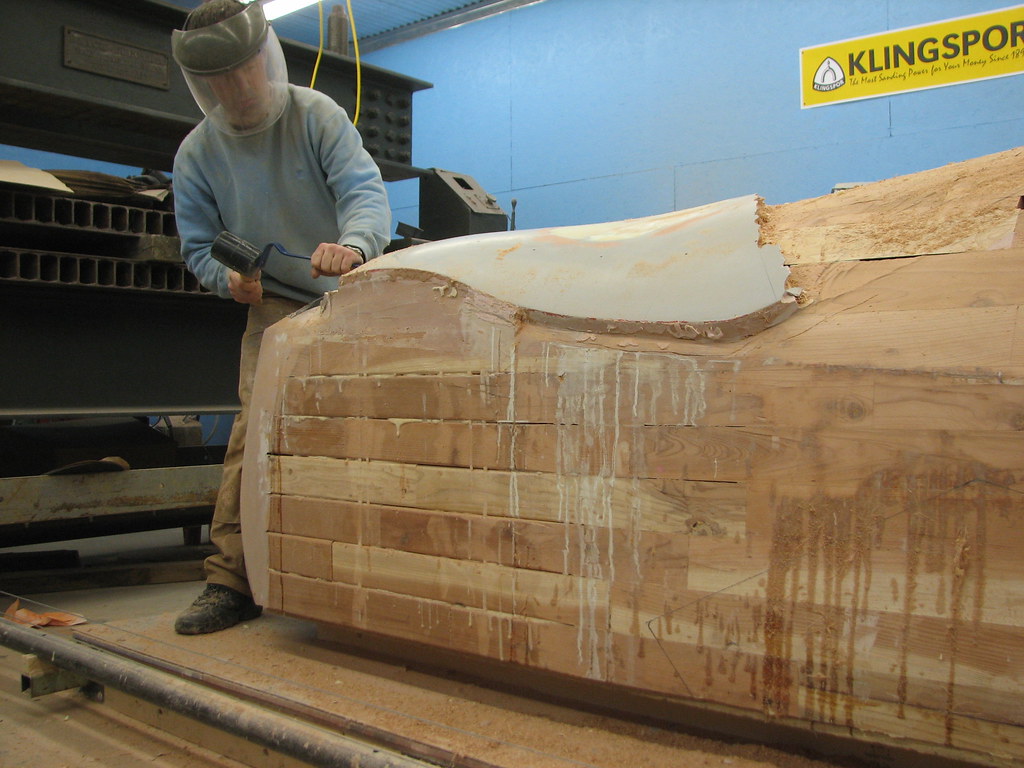
Back in the saddle today. Aaron, Zac and I performed a major shop cleanup today. Since we are finished with fiberglass for a while, we removed all the unnecessary, associated accouterments. We finally for the radial arm saw set up the way we want it in the infeed/outfeed tables. Aligning and leveling the tables took some work, as did cutting and fitting the MDF tabletops. After the guys left, I started removing the passenger's side butterfly panel. Destroying a surface that we worked so hard on was extremely painful, but the panel is useless now that we have the mold made from it. I ground the underlying panel roughly to where it should be as I went along. I got about 3/4s of it done before I went to bed.

Thursday, January 17, 2008

17 Jan 08

I was out of town in Atlanta all day today, but Zac and Hunt got a lot done without me. They welded up the legs for our infeed/outfeed tables for the tablesaw and radial arm saw, and they added legs to the fiberglass cradle we made the will hold the butterfly panel molds. I should go out of town more often. Maybe if I leave for long enough, I will come back, and the car will be finished. You think?

Wednesday, January 16, 2008

16 Jan 08


More mold work to do today. We are preparing the undersides of the butterfly panel molds to make them easier to work with during the molding process. Ben worked on the back of the mold, skimming the whole surface with body filler and refining the symmetry. Aaron and I made a box to hold the windshield while we try to CNC-waterjet cut it again. We are going to fill the box with polyurethane foam which will expand and conform the windshield, providing the uniform support we need to cut it without cracking it. Zac did some fiberglass work today on our butterfly panel mold supports, and Aaron did some computer work.

Tuesday, January 15, 2008

15 Jan 08


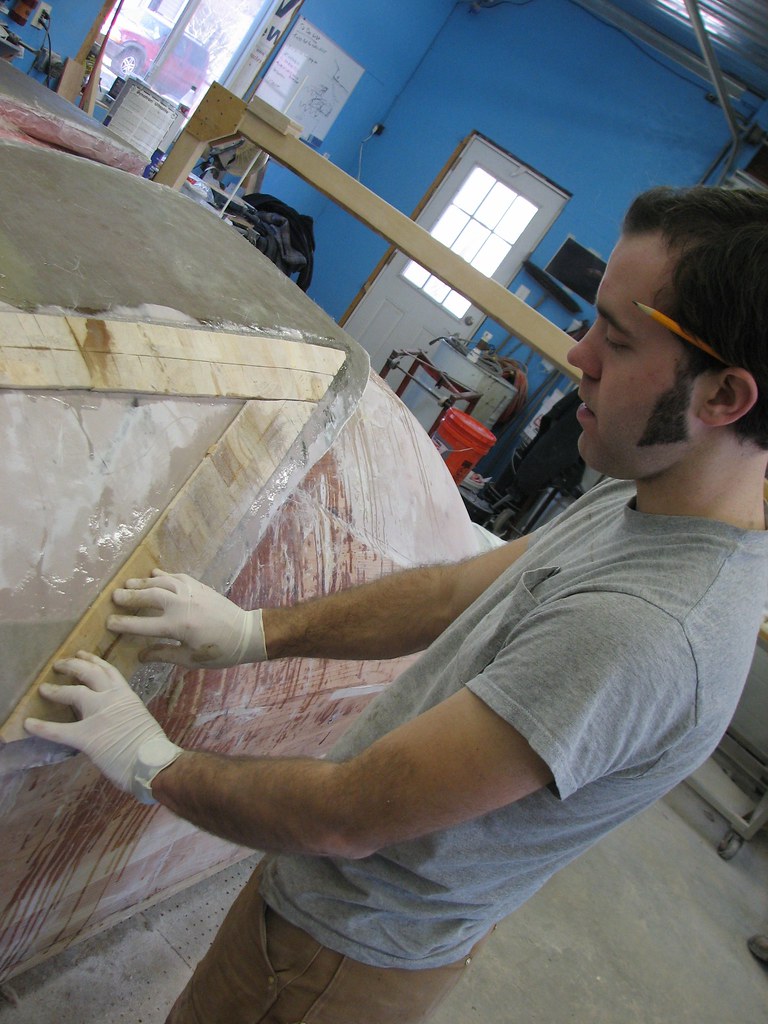
I successfully got my license first thing this morning, which is good since I have to get on a plane tomorrow. When I got back to the shop, Shane and Reggie were here from the power company to run the power line from the street to the shop. We had been subbing the electricity off the breaker on the back porch of the house and did not have enough juice to run our press, plus the lights dimmed every time the compressor fired up, which wasn't terribly comforting. It took a while to get the line pulled through the underground conduit because water had frozen inside, but we finally got it going. Zac, Ben and I coated the driver's side of the butterfly panels in a layer of chopped strand mat until Aaron came with the pizza for lunch. Since we are done with fiberglass for a while, Zac, Ben and I spent a while cleaning up in the shop. Hunt popped the fiberglass molds from the butterfly panels, and Zac and Ben each cleaned up the edges of one. The inside surface looks really nice. Tomorrow we will likely tear off the butterfly panels and finish sculpting the underlying surfaces. Aaron finished up some loose ends on the website for most of the day, then helped Zac take down a fence out back at the end of the day.

FAQ

There have been quite a few questions regarding the Splinter. Below we have addressed the most commonly asked questions. If you have a question that is unanswered here, please post it on our forum, as we would love to try to answer it.


WOODEN CAR FAQ


Why is there a need for a wooden car?

We are building a wooden car mostly to learn and share ideas. The knowledge that we are gaining from building the car is alone worth the time, effort, and money we are spending on it. We hope that it will spark some creativity in other people. People are so caught up in thinking that the wood will burn or crack or splinter because they fail to see wood as just another material that has its advantages and disadvantages. The way we use wood is almost identical to the way carbon fiber and fiberglass are used, so there is really nothing to be afraid of.


How long will it take to build?

We have spent about a year and a half so far, and we have about another 8 months to go. In starting a project like this from the ground up, we run into so many challenges that we have to work through. There is a learning curve that we have to traverse for almost every part we make. Fortunately, as we have gone along, this curve has become shorter and shorter. We have found that there is a deceptively huge amount of work involved in almost everything, too. The wheels, for example, are each made up of over 300 pieces.


Have you had any interest from potential backers?

We are financing the car ourselves, and we just haven’t sought any help from financial backers. We are not sure what we will do with the car when we finish it, so we don’t want to have to make any promises to investors right now. However, we have been lucky enough to have gotten loads of help from people in the industry like Delta/Porter-Cable, Daubert Chemical, and Becker Acroma, just to name a few. We have had a huge amount of materials and technical support donated from companies like these that like to stay on the forefront of what’s going on in woodworking.


How fast can it go?

We aren’t particularly interested in opening the bag of worms associated with a top speed claim, but based totally on projected horsepower and curb weight, frontal area, and gearing, the car will be capable of speeds in excess of 240mph. With that said, there are certainly a myriad of real world conditions that would affect this figure, and the event that this will ever even be tested is not a guarantee.


Do you think there will be a genuine interest in the market?

I don’t harbor much doubt that a lot of people will want to have one, but I would be surprised to see any wooden cars on the road any time soon. The amount of labor involved in the manufacturing process is very high, and I am not sure if people will ever get over the gratuitous fear of the safety aspect. To use wood to the extent that we have used it probably wouldn’t be practical on many vehicles, but we do feel that we have come across some ideas that could be carried over and used in more normal vehicles.


Surely if it sets on fire it is more likely to go up in flames?

The circumstance most likely to cause a fire in the Splinter is the ignition of a ruptured gas tank. While there is no conventional car that would fare well in such an incident, certainly a greater percentage of the Splinter would be consumed in a fire than of an ordinary vehicle. Either way, if a car catches on fire, you get out of it as soon as you can. We have put a large amount of effort into absorbing, reflecting and evacuating different heat sources in the engine bay, and we will fit an automatic fire extinguishing system for extra protection. Fire will not be any more of an issue in the Splinter than it is in any internal combustion vehicle.


Do you think the Splinter can compete with the top supercars?

Speaking in terms of performance, the potential is definitely there. We don’t have the time or the resources to put the Splinter through the same kind of testing and refinement that one would see in an Enzo or a Carrera GT, but we have designed it to have world-class characteristics in all the areas that make a supercar super, like power-to-weight ratio, weight distribution and center of gravity.


What top speed are you aiming for?

To me, top speed is more of a by-product of a proper supercar than a goal for one. There are so many other factors that take precedence over top speed that it wouldn’t make sense for us to set a top speed goal. If we make the car light enough, powerful enough, and slippery enough, it will be able to move faster than we will probably ever ask it to.


What are the pros of working with wood?

Wood is a truly amazing material to work with. It has a higher strength-to-weight ratio than aluminum or steel, and it possesses a versatility that makes many different types of construction techniques possible. The look, feel, and smell of a natural material like wood are not seen elsewhere and cannot be faked, and the satisfaction involved in making something from a piece of wood is awesome.

Strength to weight ratios - the higher the better


Strength to Embodied Energy Ratios - the lower the better


What are the cons of working with wood?

There is not much room for error with wood. All the laminations, fits, glues, and finishes have to be dialed in. There is no welding up a hole or bending a piece to make it fit. The main con is probably the fact that wood has almost no ability to stretch. Think of trying to conform a piece of paper to a globe. Compound curves like those seen in the Splinter’s body panels are extremely labor intensive and difficult to make in a wood laminate.


What’s your background?

I graduated from the School of Design at North Carolina State University in December 2006. My major was Industrial Design. I am currently finishing up my Master’s Degree in Industrial Design from the same school. I have always wanted to design cars.


How do you avoid problems such as wood worm and wood rot?

The magic of modern coatings along with the proper selection of woods virtually eliminates problems of worm and rot. Keeping the car out of the rain won’t hurt, either. Just like with carbon fiber, UV light is a big concern. On a painted car, this problem goes away, but a natural finish like the Splinter will have must be protected. The best protection is shade, but the coatings we have gotten from Becker will greatly retard UV degradation.


Will it be lighter than a conventional car?

We hope the car will weigh about 2500lbs, which is less than 100lbs heavier than a late-model Miata, but with well over 3 times the power. The light weight is achieved through careful design and composite construction. The Splinter is not made from any carved-out, solid chunks of wood, but rather molded laminates. This type of construction is essentially identical to that employed in cars or other objects which are made of fiberglass or carbon fiber. By building thickness in a molded part with a lightweight material, one exponentially increases the stiffness. One of the things that additional time and funds would allow us to accomplish would be a lightening of the chassis and various other components. We lean heavily towards the side of overbuilding our parts because we don’t have time to stress test everything to make it only exactly as strong (and heavy) as it needs to be.
Video of the Day

Today We added a feature to the blogs and to the website - A Video of the Day.
Also don't forget to check out our Youtube Channel-Joe Harmon

Monday, January 14, 2008

14 Jan 08


I had to go to the DMV first thing this morning to replace my lost license; fortunately, their computers were down, and I have to go back tomorrow. I would have been really bummed out if I could have only gone all the way over there to wait in line only once this week. After that, Hunt, Zac, Ben and I started in on the passenger's side butterfly mold. We cut strips of chopped-strand mat, saturated them with resin, and covered them with strips of tessellated, end-grain balsa. We made a network of this formation across the entire panel. We then ground a bevel onto the edges of the balsa in conjunction with body filler to ease the transitions for the layer of chopped-strand mat that we were to apply next. We left at least a 2" border all the way around the balsa at the edge of the panel to allow the top layer of chopped-strand mat to bond with the fiberglass underneath the balsa. We worked really well today and got the passenger's side completely finished and the driver's side ready for the top layer of chopped strand mat first thing in the morning. Aaron made some improvements to the webcam, along with getting a list put up illustrating the tools we used on most of our parts in Splinter Vision.

Sunday, January 13, 2008

13 Jan 08


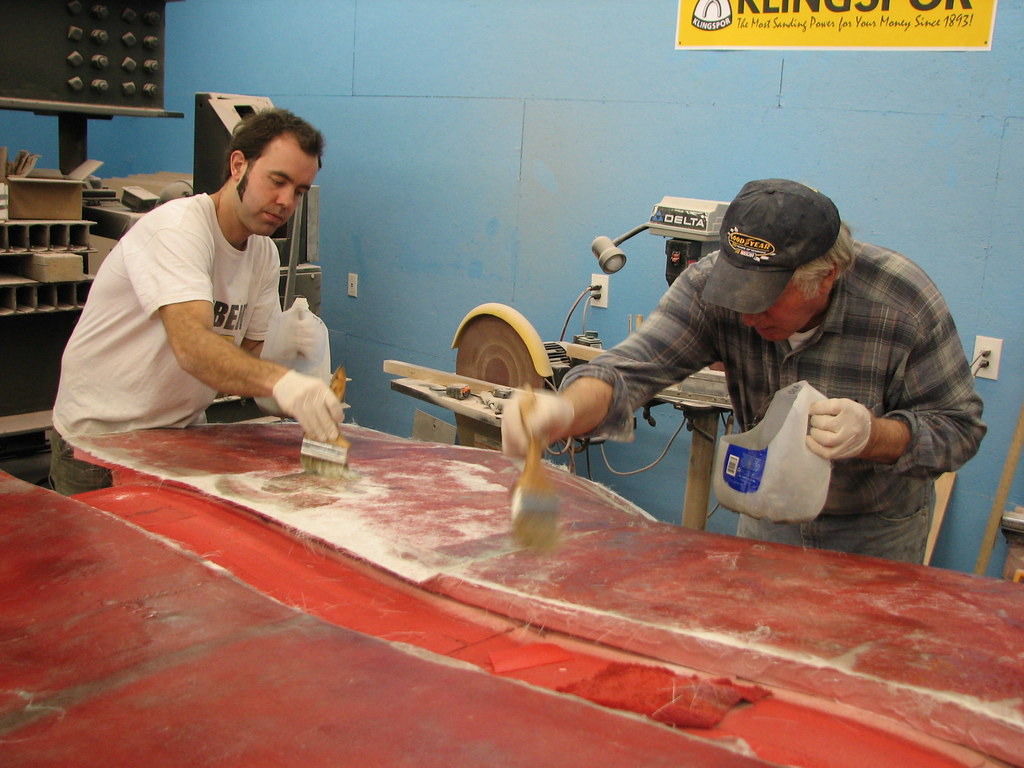
Hunt and I put another layer of fabmat on the butterfly panels this morning. We then had to run to Home Depot for a gallon of fiberglass resin to mix in with our primary resin. After lunch and ample resin-curing time, we laid up a layer of chopped strand mat and a layer of boat cloth onto each butterfly panel. Once we finished that, I went off and found a box of tessellated, end-grain balsa that we are going to look at using to stiffen up the mold. We have finished most of the fiberglass work on the butterfly panel molds, so we feel pretty good about today.

Saturday, January 12, 2008

12 Jan 08


First thing this morning, Hunt and I applied a layer of fabmat to each butterfly panel. That stuff is probably about as thick as you can go in one shot; I guess it gave us almost 1/8" of thickness. We used rollers, brushes, and squeegees to force the fiberglass resin into the fabmat. We had to wait quite a while for that to cure, so we went off to the junkyard to look for something to make a rack for all of our fiberglass rolls. We have 4 rolls of different kinds of fiberglass material that each weigh over 100lbs, and we need something to hold them and dispense fabric. We amazingly found almost the perfect device that required only slight modification to function. Unfortunately, it is made of stainless and set us back quite a few bucks. Anyway, I spent the next hour or so getting the rack ready after lunch and loaded the rolls onto it. It is a real beauty; now I don't have to pick up heavy rolls of fiberglass all day and incur constant forearm itch. After getting the rack rolling, Hunt and I laid up a layer of chopped strand mat and a layer of boat cloth on each butterfly panel and left it to cure. I have had enough fiberglass to last me until tomorrow; time to call it a day.

Friday, January 11, 2008

11 Jan 08


Bad news today, as we suffered a loss to the team. Pitch had been missing for 5 days today and was finally found in a drain pipe near the street. We suspect he was hit by a car. We are all pretty sad about it, but at least it is good to have some closure. He will be missed.
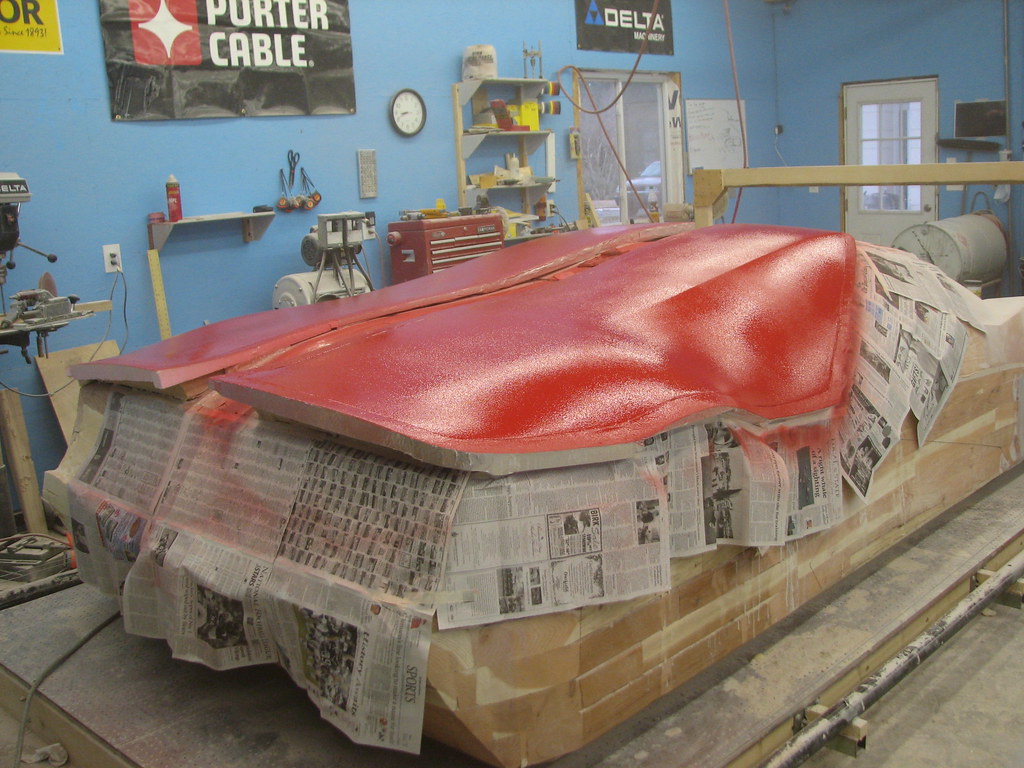
First thing this morning, Hunt and I sprayed gel coat onto the butterfly panels. If everything works properly, this will ultimately adhere to the fiberglass and release from the butterfly panels. We had to wait several hours for the gel coat to dry, so we ran a few errands. We got Aaron and Zac some concrete and some 4X4s to start a new building that will house our body mold. We had a visit from a guy named Ben today who might be interested in helping us out on the car, so we look forward to that possibility. Hunt and I got a layer of chopped strand mat and a layer of boat cloth on the butterfly panels before the day was out. Tomorrow, we start building thickness with the fabmat, which is a combination of woven roving and chopped strand mat bound by a thermoplastic resin. Once we get these butterfly panel molds completed, we can tear the butterflies off and finish the rest of the body mold which lies underneath them.

Thursday, January 10, 2008

10 Jan 08


HAAAAAlleluuujah, halleluuujah, halleluuujah. I could have sworn that song was playing on The Classical Station tonight, but it turned out to be in my head. The butterfly panels are finished and ready for making fiberglass molds. Hunt and I just finished putting 3 coats of carnauba wax on them, and tomorrow we will spray the gel coat. I will sleep well tonight. Aaron worked on increasing the browser capability of our website today to good results. We found that our site was not fully compatible with Internet Explorer 6, and that, amazingly, almost 60% of our visitors used this browser. Zac finished the roof on the lean-to during intermittent rain which undoubtedly made him wish he had stayed home.

Wednesday, January 9, 2008

09 Jan 08


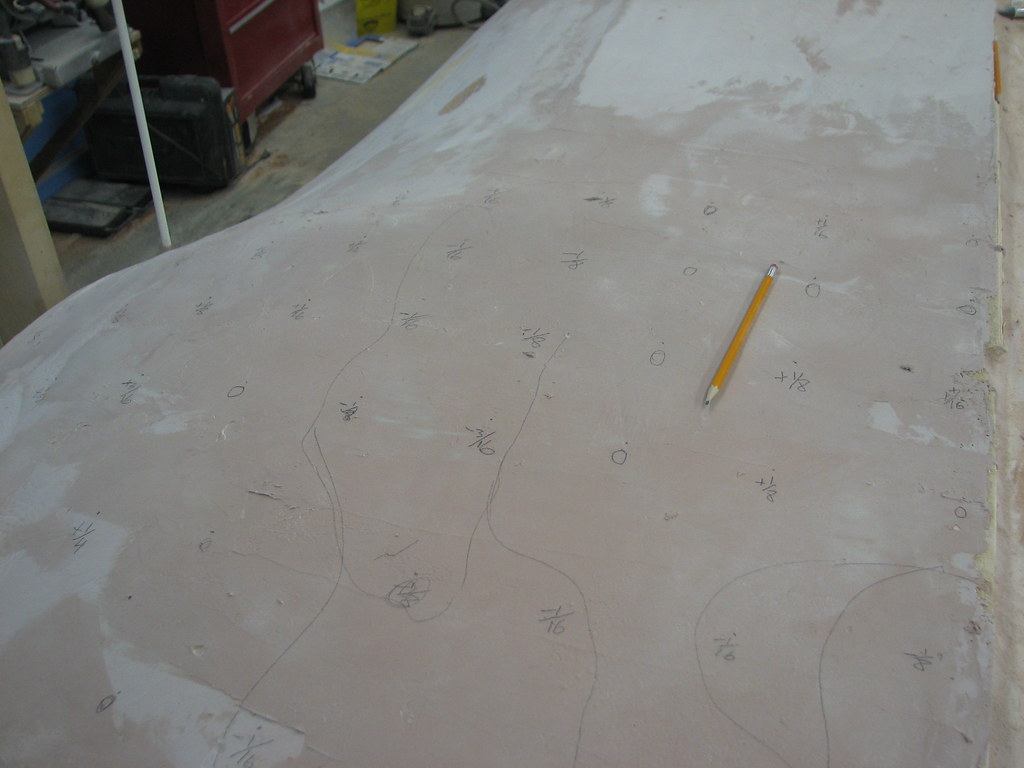
I hate to say it, but I worked on the butterfly panels all day today again. Since the surfaces were sprayed with body filler last night, they were much easier to read this morning. Hunt and I found a couple of places that needed to be addressed, so we worked to get them right. I am going to try to get the surface block sanded a final time tonight so that we can spray it with body filler again tomorrow before lunch. Aaron and Zac got half of the corrugated tin up on the roof of the lean-to, and will probably finish it tomorrow. We will probably wall it in, so that could be their next project. I am sure they are bubbling with joy. Heheh.

Tuesday, January 8, 2008

08 Jan 08


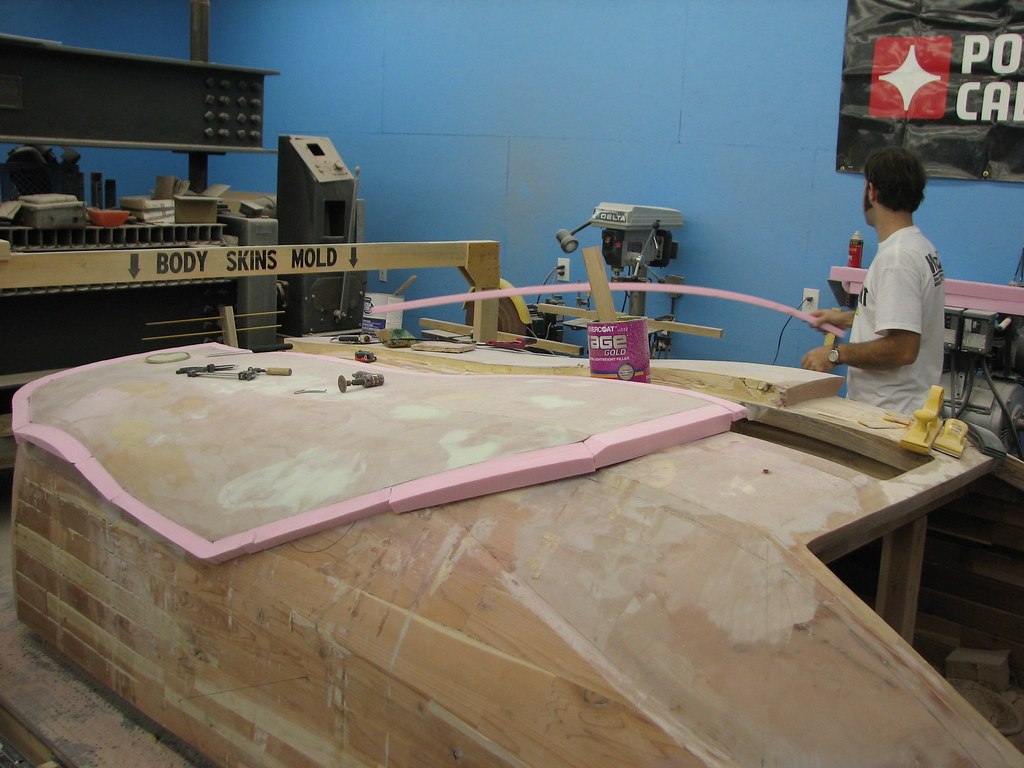
I spent the morning sanding down the foam stripped edges on the butterfly panels today. I covered the foam in aluminum duct tape to keep the polyester resin from dissolving it. I then had to run to Home Depot to get some brackets for Zac and Aaron, who were working on the lean-to. They got the rafters ready for the roof and carried the sheets of OSB up there. Tomorrow, they nail it down after everything is squared up. We wanted to wait until the end of the day to spray a layer of body filler on the butterfly panels, so I worked on the rear end a little bit to kill some time. I had gotten a little aggressive with the electric chainsaw a month or so ago when I was rough carving, so I made a dam, mixed up some urethane foam, and poured it on. This foam expands and hardens to create the volume I need to properly shape the tail. Tomorrow, I have some more fine work to do on the driver's side butterfly panel, after which we should be ready to start laying up our fiberglass molds. I am not particularly looking forward to that, but we have to do it. Story of my life. In other news, Howard Miller from Becker Acroma came by today, which was cool. It's always good to see our buddies.

Monday, January 7, 2008

07 Jan 08


Today I finally got the driver's side butterfly panel ready. After working on that surface for most of the day, I started stripping the edges of the panels in expanded polystyrene foam. I needed to do this so that the mold would be bigger than the finished part. We make all of our molds bigger than the finished part so that there is room to trim the part to its final shape. The only problem with this foam stripping idea is that polyester resin dissolves polystyrene. Fortunately, we got some aluminum duct tape to cover the foam with to prevent this from happening when we make our fiberglass mold. I also used some expanding foam-in-a-can used for sealing windows and other gaps to fill in the cracks and spaces I left when I was stripping the edges. We have found before that this stuff doesn't sand very well, but it shouldn't be too much of a problem, because it was used sparingly. Zac and Aaron worked on the lean-to most of the day. Tomorrow, we might have some semblance of a roof on that bad boy.

Sunday, January 6, 2008

06 Jan 08

I worked on the driver's side butterfly panel all day again today. I spent a long time working on the edges, which were a real challenge to get right. I never got to the stage of super-refined block sanding, but the panel is very close to being right and only in need of minor refinement. Nothing too exciting happened today, just a lot of measuring, body filler work, and sanding. It will be quite disappointing if I don't finish the panel totally tomorrow.

Saturday, January 5, 2008

05 Jan 08


I worked on the butterfly panel all day today. The symmetry afforded by our lofting arm is incredible; I will never do another car without one of these babies. I feel pretty confident that the panel will be totally finished tomorrow. The panel now has very good symmetry with respect to the other panel; I simply need to spend some time skimming the panel with body filler and block sanding the surface. The body filler gallon count now stands at 11. Hunt worked with the fiberglass resin some more today. He has it pretty well dialed in now after discovering that the MEKP we were using was bad. Caroline heated some toluene and melted paraffin wax into it. Adding this solution to the fiberglass resin will help prevent the surface layer from oxygen-inhibiting. This will help when it comes time to sand it.

Friday, January 4, 2008

04 Jan 08

I essentially worked on the butterfly panel all day today. It's eyeball symmetrical, but it isn't a nice surface yet, and the symmetry will be refined more. I should just about have it tomorrow, since I usually get a lot done on Saturdays due to a relative shortage of interruptions. Hunt did a lot of work getting our polyester resin system working. We were able to get 55gal drum of unpromoted resin for almost nothing, but we didn't know exactly how much cobalt napthenate to use with our particular resin. Fortunately, Hunt spent a good part of the day and figured it out. We also got some paraffin wax to mix in to protect the surface layer from oxygen-inhibition and the resulting clogged sandpaper. We will be ready to start making fiberglass molds soon. Aaron and Zac got the headers up for the lean-to today, and they should be able to get the rafters going on Monday.

Thursday, January 3, 2008

03 Jan 08


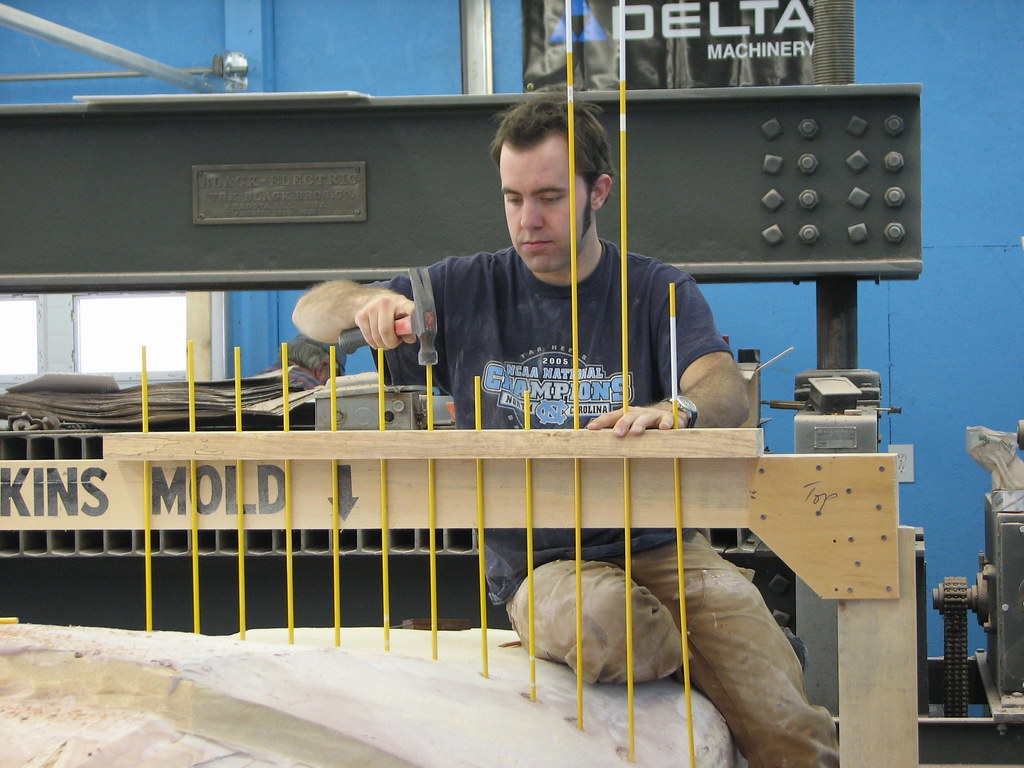
Today, Hunt and I spent the morning working on a new measuring apparatus that will work in conjuntion with our original lofting arm. We dimensioned a 2" thick piece of ash and drilled 1/4" holes in it at 4" intervals. A measuring stick fits in each of these holes. We also drilled and tapped a hole that is perpendicular to each of the aforementioned holes. We then welded up some T-handled screws that fit in each of the tapped holes to lock the measuring sticks in place. This system works pretty well, but I still use the single stick measurer most of the time. We went to Home Depot again today to get the wood for the lean-to, which ended up being just over $350. I worked on the butterfly panel the rest of the afternoon. The whole panel is skimmed in body filler, but I am sure much of it will get ground away or covered by more body filler. Aaron and Zac got our 11-horse Porter-Cable compressor covered up outside with a small shed from Hunt's place.

Wednesday, January 2, 2008

02 Jan 08

Aaron and Zac were back at work today. They had a bunch of mess in the blue room to clean up, and then they dug some holes and set some poles in concrete for a lean-to we are adding to the side of the blue room. This will house our wood body mold when we are finished with it. Hunt and I had to travel to Thomasville to get some polyester resin, some gelcoat, and some chopped-strand mat. Between getting some supplies at Home Depot for the guys to work on the lean-to, this took us almost all day. I did get some work done on the butterfly panels, but not as much as I had hoped. Caroline is coming home tonight for Florida. No more PB&Js for lunch.

Tuesday, January 1, 2008

01 Jan 08


Today was a productive day on the mold. This morning, I prepared the underlying surface of the butterfly panels and had a dam built around it by noon. Next, I mixed and poured a 2part polyurethane foam onto the surface inside the dam. This foam expanded and cured into a hard material that carves easily and precisely. I spent the next couple of hours grinding and cleaning up the surface and started a coat of body filler on top of it. With another day like this tomorrow, I could finish the 2nd butterfly panel, which would really be awesome. I am keeping my fingers crossed.